martes, 20 de octubre de 2015

Inteligencia emocional en el desarrollo profesional.

                       Las tensiones cada días son mayores en nuestra actividad profesional, nuestras capacidades se ponen a prueba no solamente por nuestras posibilidades de resolver problemas sino como soportamos la presión del medio que nos rodea, como interactuamos con nuestros pares.
                       Años atrás era corriente destacar el coeficiente intelectual de una individuo para determinar su capacidad para desarrollarse en actividades críticas, como si fuera un índice que demostraba por si solo que un individuo podría resolver cualquier situación a la que se enfrentara.
                       Hoy todos sabemos que un buen IQ no basta!!!. Si no tenemos una inteligencia emocional para enfrentar conflictos y manejar diferentes sucesos nuestros éxitos empresariales serán escasos!!
                       La nota que transcribiremos exhibe como un profesional tiene que armar un rompecabeza entre su personalidad, su coeficiente intelectual y su inteligencia emocional para poder alcanzar resultados satisfactorio en sus actividades.

La nota a transcribir tiene como fuente el link: http://www.entrepreneur.com/article/241998
When emotional intelligence first appeared to the masses, it served as the missing link in a peculiar finding: people with average IQs outperform those with the highest IQs 70% of the time. This anomaly threw a massive wrench into what many people had always assumed was the sole source of success—IQ. Decades of research now point to emotional intelligence as the critical factor that sets star performers apart from the rest of the pack.
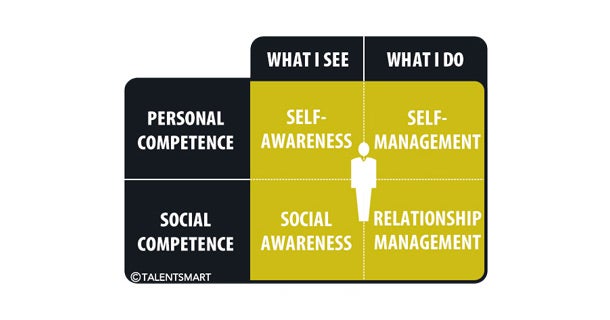
Emotional intelligence is the “something” in each of us that is a bit intangible. It affects how we manage behavior, navigate social complexities, and make personal decisions that achieve positive results. Emotional intelligence is made up of four core skills that pair up under two primary competencies: personal competence and social competence.
Why You Need Emotional Intelligence To Succeed
Personal competence comprises your self-awareness and self-management skills, which focus more on you individually than on your interactions with other people. Personal competence is your ability to stay aware of your emotions and manage your behavior and tendencies.
  • Self-Awareness is your ability to accurately perceive your emotions and stay aware of them as they happen.
  • Self-Management is your ability to use awareness of your emotions to stay flexible and positively direct your behavior.
Social competence is made up of your social awareness and relationship management skills; social competence is your ability to understand other people’s moods, behavior, and motives in order to respond effectively and improve the quality of your relationships.
  • Social Awareness is your ability to accurately pick up on emotions in other people and understand what is really going on.
  • Relationship Management is your ability to use awareness of your emotions and the others’ emotions to manage interactions successfully.

Emotional Intelligence, IQ, and Personality Are Different

Emotional intelligence taps into a fundamental element of human behavior that is distinct from your intellect. There is no known connection between IQ and emotional intelligence; you simply can’t predict emotional intelligence based on how smart someone is. Intelligence is your ability to learn, and it’s the same at age 15 as it is at age 50. Emotional intelligence, on the other hand, is a flexible set of skills that can be acquired and improved with practice. Although some people are naturally more emotionally intelligent than others, you can develop high emotional intelligence even if you aren’t born with it.
Why You Need Emotional Intelligence To Succeed
Personality is the final piece of the puzzle. It’s the stable “style” that defines each of us. Personality is the result of hard-wired preferences, such as the inclination toward introversion or extroversion. However, like IQ, personality can’t be used to predict emotional intelligence. Also like IQ, personality is stable over a lifetime and doesn’t change. IQ, emotional intelligence, and personality each cover unique ground and help to explain what makes a person tick.

Emotional Intelligence Predicts Performance

How much of an impact does emotional intelligence have on your professional success? The short answer is: a lot! It’s a powerful way to focus your energy in one direction with a tremendous result. TalentSmart tested emotional intelligence alongside 33 other important workplace skills, and found that emotional intelligence is the strongest predictor of performance, explaining a full 58% of success in all types of jobs.
Your emotional intelligence is the foundation for a host of critical skills—it impacts most everything you do and say each day.
Why You Need Emotional Intelligence To Succeed
Of all the people we’ve studied at work, we've found that 90% of top performers are also high in emotional intelligence. On the flip side, just 20% of bottom performers are high in emotional intelligence. You can be a top performer without emotional intelligence, but the chances are slim.
Naturally, people with a high degree of emotional intelligence make more money—an average of $29,000 more per year than people with a low degree of emotional intelligence. The link between emotional intelligence and earnings is so direct that every point increase in emotional intelligence adds $1,300 to an annual salary. These findings hold true for people in all industries, at all levels, in every region of the world. We haven’t yet been able to find a job in which performance and pay aren’t tied closely to emotional intelligence.

You Can Increase Your Emotional Intelligence

The communication between your emotional and rational “brains” is the physical source of emotional intelligence. The pathway for emotional intelligence starts in the brain, at the spinal cord. Your primary senses enter here and must travel to the front of your brain before you can think rationally about your experience. However, first they travel through the limbic system, the place where emotions are generated. So, we have an emotional reaction to events before our rational mind is able to engage. Emotional intelligence requires effective communication between the rational and emotional centers of the brain.
Why You Need Emotional Intelligence To Succeed
Plasticity is the term neurologists use to describe the brain’s ability to change. As you discover and practice new emotional intelligence skills, the billions of microscopic neurons lining the road between the rational and emotional centers of your brain branch off small “arms” (much like a tree) to reach out to the other cells. A single cell can grow 15,000 connections with its neighbors. This chain reaction of growth ensures it’s easier to kick a new behavior into action in the future.
As you train your brain by repeatedly practicing new emotionally intelligent behaviors, your brain builds the pathways needed to make them into habits. Before long, you begin responding to your surroundings with emotional intelligence without even having to think about it. And just as your brain reinforces the use of new behaviors, the connections supporting old, destructive behaviors will die off as you learn to limit your use of them.

lunes, 12 de octubre de 2015

Las PYMES y la necesidad de tener una web

                       En la nota que procederemos a transcribir en esta entrada se enumerarán las cuestiones por la que una empresa tiene que desarrollar una página web.
                       Pero subiendo la apuesta, le diremos que una web con claridad de conceptos hace a la supervivencia misma de la PYMES!
                 En la actualidad es innecesario dejar catálogos, muestras o lo que sea para promocionarnos dado que los receptores no quieren llenarse de material que no tienen ni lugar para guardarlo. Por lo general cuando nos encontramos con un posible cliente no los tenemos al alcance y perdemos nuestra oportunidad de oro para exhibir nuestros productos y servicios pero siempre tenemos acceso a internet!!!!. Y nuestro cliente la puede analizar cuando quiere y se la puede exhibir a quien entienda pertinente para hablar sobre nosotros!!!.
                       Llego la hora de replantearse que el mundo virtual hace a nuestra realidad diaria y debemos ponernos a trabajar en ello!!!

La nota a transcribir tiene como fuente el link:
http://www.estrategiaynegocios.net/lasclavesdeldia/889299-330/ocho-razones-por-las-que-las-pymes-necesitan-un-sitio-web
A continuación le expongo ocho razones que le mostrarán por qué su empresa necesita un sitio web profesional, indistintamente del tamaño de la misma.
1. Su empresa obtendrá credibilidad. Hoy en día, tenemos cada vez más incrementos en el número de consumidores que utilizan Internet para buscar los productos o servicios que necesitan. Los consumidores conectados usan como referencia la información que obtienen a través de resultados en buscadores; por lo que su pequeña o mediana empresa obtendrá credibilidad por tener un sitio web optimizado para motores de búsqueda.
Efecto contrario padecerá, si al momento de hacer sus investigaciones en Internet, los buscadores en lugar de dirigirles a usted, desvían a sus clientes potenciales hacia sus competidores. Si usted ya tiene una página web, pero ha sido hecha en modo amateur, recomiendo evaluar un rediseño ya que un sitio elaborado por personas especializadas proporcionará a su negocio una imagen profesional, que inspirará mayor confianza a los consumidores reales y potenciales de su marca.
2. Un sitio web ahorra dinero. Como propietario de una pyme, usted probablemente piensa que no puede darse el lujo de contar con un sitio profesional por los costos que genera; sin embargo, tampoco puede permitirse no tenerlo. En comparación con el costo de un anuncio en el periódico y teniendo en cuenta el mercado potencial al cual se puede llegar con un sitio web (alcance), esta herramienta representa una manera muy rentable y mucho más económica de promover su negocio.
3. Le permitirá mantener informados a sus clientes. Piense en su sitio web como su folleto o catálogo en línea. Es mucho más fácil y más rápido actualizar la información sobre sus productos y servicios en su sitio que en material de impresión, por lo que es una manera eficaz de dejar que sus clientes sepan sobre la llegada de nuevos productos, eventos, promociones especiales o los nuevos servicios que tiene la marca para ofrecer.
4. Siempre es accesible. Un sitio web está disponible tanto para sus clientes habituales como para sus clientes potenciales 24/7, los 365 días del año, brindándoles la oportunidad de revisar los productos y servicios de su empresa, aun cuando su negocio físico se encuentra cerrado.
5. Hace posible conseguir un mercado más amplio e incrementa sus ventas. Ya sea que usted proporcione productos o servicios, su sitio web le ofrece una ubicación alternativa para venderlos. Como minorista, un sitio web es un gran lugar para vender sus productos a un mercado más amplio, abriendo oportunidades de comercialización a nivel mundial.
6. Proporciona un medio diferente para mostrar su trabajo. No importa qué tipo de negocio tenga o esté por emprender, un sitio web es un gran lugar para mostrar su trabajo. Al incluir en su sitio una cartera o galería de imágenes de los productos o servicios que ofrece o testimonios de su empresa, puede mostrar lo que hace de su negocio algo único.
7. Un sitio web ahorra tiempo. Proporcionar información a sus clientes requiere tiempo; ya sea por teléfono, cara a cara, en un folleto o a través de co-rreos electrónicos, responder las preguntas de sus clientes distrae al personal de sus obligaciones o responsabilidades diarias.
Con un catálogo en línea puede brindar mucha información sobre sus productos y servicios. Una vez que su sitio se encuentre en servicio, estará disponible para sus clientes de forma indefinida, ahorrándole tiempo y recursos.
8. Mejora su servicio al cliente. Tal vez usted vende productos amigables con el ambiente y quiere compartir consejos sobre cómo reciclar, o tal vez usted es un contador y desea dar a sus clientes asesoramiento sobre cómo simplificar sus prácticas de contabilidad… En su sitio, puede además de simplemente informar a sus clientes sobre sus productos o servicios, ganar credibilidad al subir artículos o publicar boletines que mantendrán a sus clientes ac-tualizados.
SUGERENCIAS
1. La mayoría de los clientes de hoy en día son consumidores conectados, por lo tanto estos mismos asumirán que su empresa tiene un sitio web y comenzarán a buscar su negocio a través de la red. La mayoría de sus competidores probablemente ya tiene un sitio. Usted no solo debe tenerlo, sino que debe ir más adelante y desarrollar toda una estrategia de marketing digital que posicione a su empresa.
2. Por sí solo un sitio web no es una útil herramienta de marketing. Siempre recomendamos promover y publicitar su sitio mediante la inclusión de la direc-ción web en toda su impresión de material y papelería, tales como tarjetas de visita, folletos, carteles, recibos y facturas. Y cuando asista a otros eventos, no se olvide de mencionar su sitio.
Utilice sus medios digitales como Facebook, Twitter, Instagram para atraer tráfico al sitio, incluya información esencial y dinámica para captar la atención y ganar el interés de los clientes potenciales, dirigiéndolos a visitar su sitio para más información. De esta manera, se puede reducir la cantidad, el tamaño y la frecuencia de su material de impresión y por lo tanto reducir costos.
3. Si va a actualizar su contenido de forma regular debe considerar dar un mantenimiento del sitio ad-ministrado. La mayoría de los proveedores de alojamiento web ofrecen algún tipo de software de gestión de contenidos que permite actualizar fácil y rápida-mente su propio contenido.
4. Añada un blog o sección de Q&A (preguntas y res-puestas) a su sitio web. Si sus clientes realizan las mismas consultas periódicamente es sumamente importante agregar una página de preguntas frecuentes acerca de su producto o servicio. Esto no solo le ahorrará tiempo al no tener que repetir las mismas respuestas, sino que también impulsará tráfico adicional a su sitio web y potencialmente aumentará las ventas.
5. Los enlaces entrantes desde Facebook, Twitter, LinkedIn, YouTube, Vimeo, Flickr y Google+ aumentarán su motor de búsqueda en la página de resultados.Recuerde que no se trata de crear una web extremadamente cara. Hoy las empresas necesitan un sitio por el hecho de generar un sentido de identidad con sus clientes para establecer lazos a largo plazo.

lunes, 5 de octubre de 2015

La necesidad de conseguir y retener clientes.

Las empresas deben trabajar constantemente en la obtención de nuevos clientes y en tratar de mantenerlos.  Las actividades que cada empresa puede realizar dependerán de su mercado, estructura y capacidad económica, pero sin lugar a dudas tendrá que ser activa, es decir, llevándose a cabo constantemente.
En la nota que transcribiremos a continuación se mencionan cinco caminos para desarrollar el marketing, pero todas llevan a la misma idea; tener que estar en la visión de nuestros clientes. Es necesario que estos siempre nos tengan en cuanta en el momento de tomar sus decisiones, que nuestros productos y servicio sean una opción.
Al fin y al cabo, como sostiene Woody Allen, el 90% del existo consiste en estar presente en el momento que suceden los hechos!!

La nota a transcribir tiene como fuente el link:
http://smallbusiness.chron.com/five-examples-marketing-activities-20573.html
Marketing isn't as simple as paid advertising on television or in newspapers. Marketing is any technique used to make the public aware of a company and what it has to offer over its competitors. The variations of marketing activities are vast and encompass almost every kind of media and company-initiated outreach.

Cold-Calling

Whether they call current customers or members of the general public, companies often simply call people up on the phone and offer them services. Although a company may not make a sale as a result of most of these calls, some calls will be successful, and brand loyalty is reinforced in existing customers even if they don't buy anything new. People who were previously unaware of the company might have their interest piqued by the call.

Newsletters and Articles

Sending out a newsletter that announces new happenings in the company, as well as informative articles about the company's industry, are other ways to get the company's message out. Companies might use either an established list of customers and periodically email out the publication, or they might publish articles in other media with which they have no obvious connection — for instance, a financial expert with a weekly advice column in a local paper in which she invites inquiries from readers has the intent to drum up business.

Search Engine Marketing

Creating a website that's among the top results on search engines is another way of marketing services. If a consumer is looking for a product or service for which there are a number of providers, she might simply enter keywords into a search engine and scan the results. Instead of thoroughly comparing each hit, she might choose to look only at the first few websites. Businesses structure their websites and infuse them with keywords and phrases designed to maximize their search engine ranking and garner the greatest volume of customer inquiries.

Trade Shows

In particular for entrepreneurs looking to find retailers to carry their product, trade shows are a form of business-to-business marketing. Owners purchase booth space and sell units of a particular item, sometimes to members of the general public but also to those who can get them shelf space in a large-volume retailer. Even if an entrepreneur doesn't sufficiently impress a retailer at a trade show, the number of units sold to everyday consumers might be enough to convince retailers later on to stock the product.

Product Placement in Entertainment

Moviegoers and online game players often notice products from a part of the script or scene. Companies pay for this privilege: They agree to a payment scheme in return for the marketing benefits that come as a result of a Hollywood star using their product. The same is true of video games, where everyday players navigate through a world populated with products they can find in their local store.